
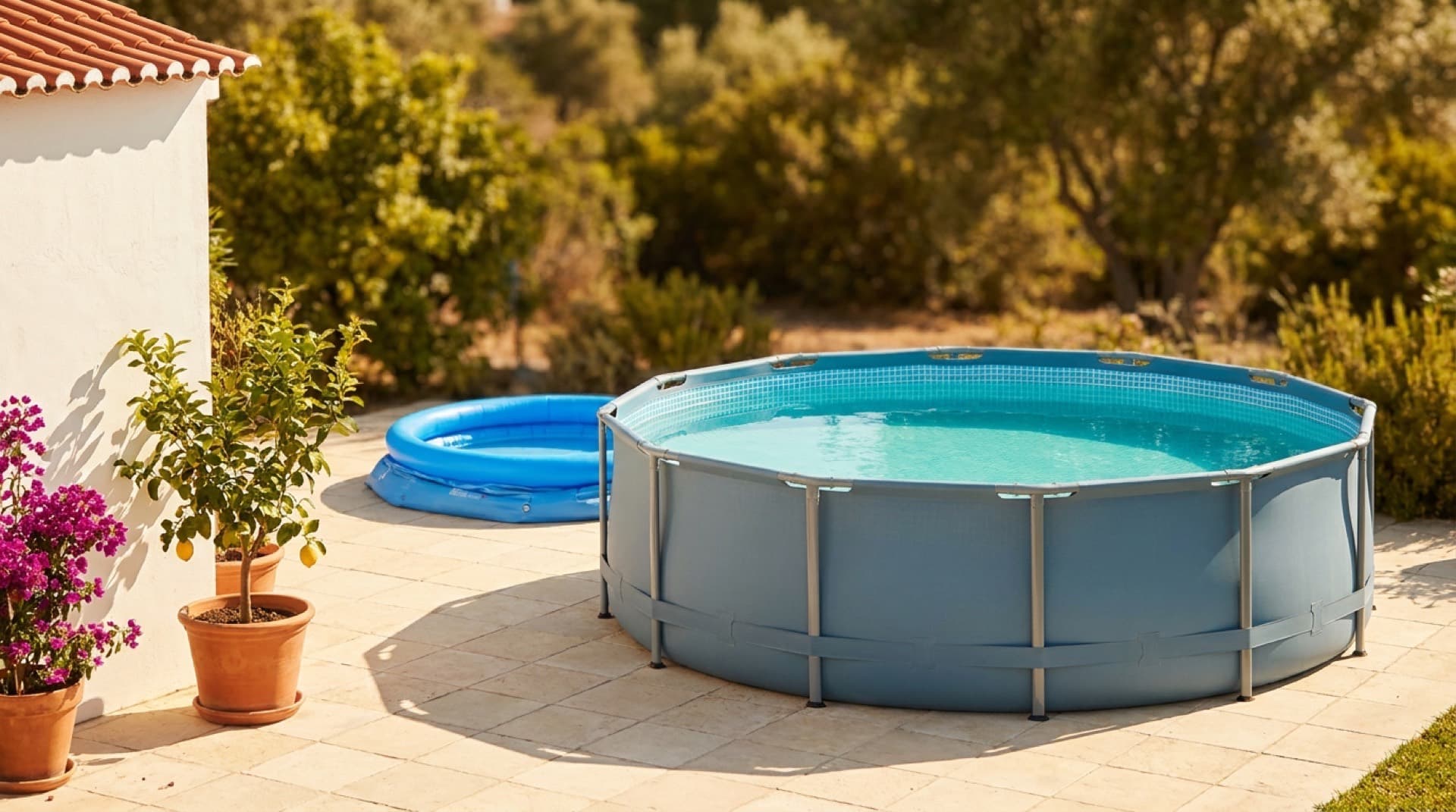
Choosing an Above-Ground Pool
Which type actually lasts in a Portuguese garden — and how to size it before you buy
Above-ground pools are the fastest-growing category of pool ownership in Portugal, and the one with the least honest information behind it. Retailers describe what the box contains; almost nobody explains which type survives three Portuguese summers, how much garden a 4.5-metre pool really needs, or what you will be spending every month once it is up. This guide covers the decision itself — before you have spent anything.
Why the Choice Matters More Here Than Elsewhere
Portugal is unusually hard on above-ground pools. The summer UV index on the coast regularly hits 9 or 10, which degrades PVC liners far faster than in northern Europe. Atlantic wind along the Linha and the Silver Coast puts real load on a lightweight frame. And a season that runs from May to late September means the water is working — and being treated — for five months rather than two. A pool chosen for a Dutch garden will not give you the same years here.
Before You Buy: Ten Things to Settle
Work through these in order. The first four decide the type of pool; the rest decide which specific model.
- 1Measure the flat area you actually have — then subtract one metre of clear working space all the way around. Most people discover their garden fits a smaller pool than they had in mind.
- 2Check the ground falls no more than about 3 cm across the full width of that area. Anything more and you are into base preparation before you can buy anything.
- 3Decide who swims. Children splashing needs 0.7–0.9 m of depth; adults wanting to cool off and float want 1.2 m or more, which pushes you out of inflatable models entirely.
- 4Pick the type honestly: inflatable ring pools for one or two seasons of light use, steel-frame tubular pools as the sensible mainstream choice, rigid-panel pools if you want something semi-permanent that stays up over winter.
- 5Confirm the liner thickness and whether the material is UV-stabilised. This single specification is the strongest predictor of how many Portuguese summers the pool will see.
- 6Check what filtration is actually included. Many kits ship with a pump sized for a pool smaller than the one you are buying, which means replacing it in the first month.
- 7Work out where the pump will plug in. It needs a weatherproof outdoor socket on an RCD-protected circuit, positioned so the cable never crosses a walkway.
- 8Plan how you will fill it. A 4.5 m round pool holds over 14 tonnes of water; filling from a garden hose takes most of a day and will show clearly on your water bill.
- 9If you rent the property out, or live in a condominium, check the rules before ordering. Some condominium regulations and most short-let insurance policies treat a pool as a notifiable change.
- 10Budget the running cost, not just the purchase. Filter cartridges, chemicals, water top-ups and electricity all run through the season, and they add up to more than most first-time owners expect.
What This Looks Like in Practice in Portugal
For most gardens in Greater Lisbon and along the Silver Coast, a steel-frame tubular pool between 3.6 m and 5.5 m is the right answer: enough depth to be genuinely refreshing, light enough to take down in October, and cheap enough that replacing it after five or six summers is not painful. Inflatable ring pools are a false economy for anything beyond very young children — the ring is the part the sun destroys first. Rigid-panel pools make sense if you intend to leave the pool standing year-round, but at that price the honest comparison is against a small fibreglass pool rather than against other above-ground models. If you would rather not make this call from a product page, our team will come and look at the site, tell you what fits, and quote the whole thing installed.
How Our Team Can Help
If you would rather not handle this yourself, these are the services that cover what you just read.
Explore More
Related Pool Types
Where We Work
Frequently Asked Questions
How long does an above-ground pool last in Portugal?
A well-chosen steel-frame pool that is dismantled and stored each winter typically gives five to eight summers before the liner needs replacing. Left standing through the winter and exposed to full summer UV, that can drop to two or three. Inflatable ring pools are usually finished after one to three seasons.
What size above-ground pool do I need?
For two adults wanting to cool off, 3.6 m is workable and 4.5 m is comfortable. For a family that will actually swim in it, 5.5 m and above. Remember that every extra metre of diameter increases the water volume — and therefore the chemical and heating cost — considerably faster than it increases the footprint.
Do I need planning permission for an above-ground pool in Portugal?
A demountable pool that is taken down seasonally is generally treated as garden equipment rather than construction, so no municipal licence is normally required. Permanent rigid-panel installations, decking built around a pool, and anything involving fixed plumbing or excavation are a different matter — check with your câmara municipal, and check your condominium rules if you have them.
Can I put an above-ground pool on a terrace or roof?
Almost never without a structural assessment. Water weighs a tonne per cubic metre, and even a modest 3 m pool concentrates six or more tonnes onto a small area. Balconies and terraces are rarely designed for that. Ground level, on prepared soil, is the safe default.
Is it cheaper to buy the pool myself or have it supplied?
The pool itself costs the same wherever it comes from — retail pricing in Portugal is fairly uniform. What changes the total is buying the right pump first time, not needing a second trip for the parts the kit left out, and not replacing a pool that failed because the base was never levelled. That is what our site visit and specification is for.
Need Professional Pool Care?
Our expert team provides comprehensive pool maintenance services across Portugal — so you can enjoy your pool worry-free.