
Renovation
Pool renovation in Portugal: which finish is best, what it costs and when it is worth it
The signs a pool needs work, when a repair is enough, pool finishes compared by price per m² and lifespan, and what a full renovation costs. Our own team handles small repairs and equipment; full renovations are carried out by experts from our network.
 Pools Portugal teamPool construction and maintenanceUpdated 10 min read
In this article
- 1.How do you know a pool needs renovating?
- 2.Should you repair or renovate your pool?
- 3.Which pool finish is best?
- 4.How is a pool waterproofed?
- 5.Which equipment is worth upgrading during a renovation?
- 6.How much does it cost to renovate a pool?
- 7.How does a pool renovation work, step by step?
- 8.Do you need a permit to renovate a pool in Portugal?
- 9.When is the best time to renovate a pool?
- 10.Frequently asked questions
- 11.Sources
Key points
- Around Lisbon, fully renovating an old pool typically costs €12,000–€28,000; renewing only the finish and the equipment costs €6,000–€18,000.
- Pool finishes cost €40–€120 per m² applied on average; an 8 × 4 m pool with a 1.5 m depth has about 68 m² of surface to line.
- A reinforced PVC membrane lasts about 15–25 years, tile and glass mosaic 20–50 years with the grout redone every 10 years or so, and paint only 3–7 years.
- A localised leak, a single crack or a broken pump can be fixed for a few hundred euros; renovating only pays off when the finish is failing across the whole pool.
- Conservation works that keep a pool as it was built are generally exempt from prior control (article 6 of the RJUE); changing its shape, size or structure is different — check with the câmara.
How do you know a pool needs renovating?
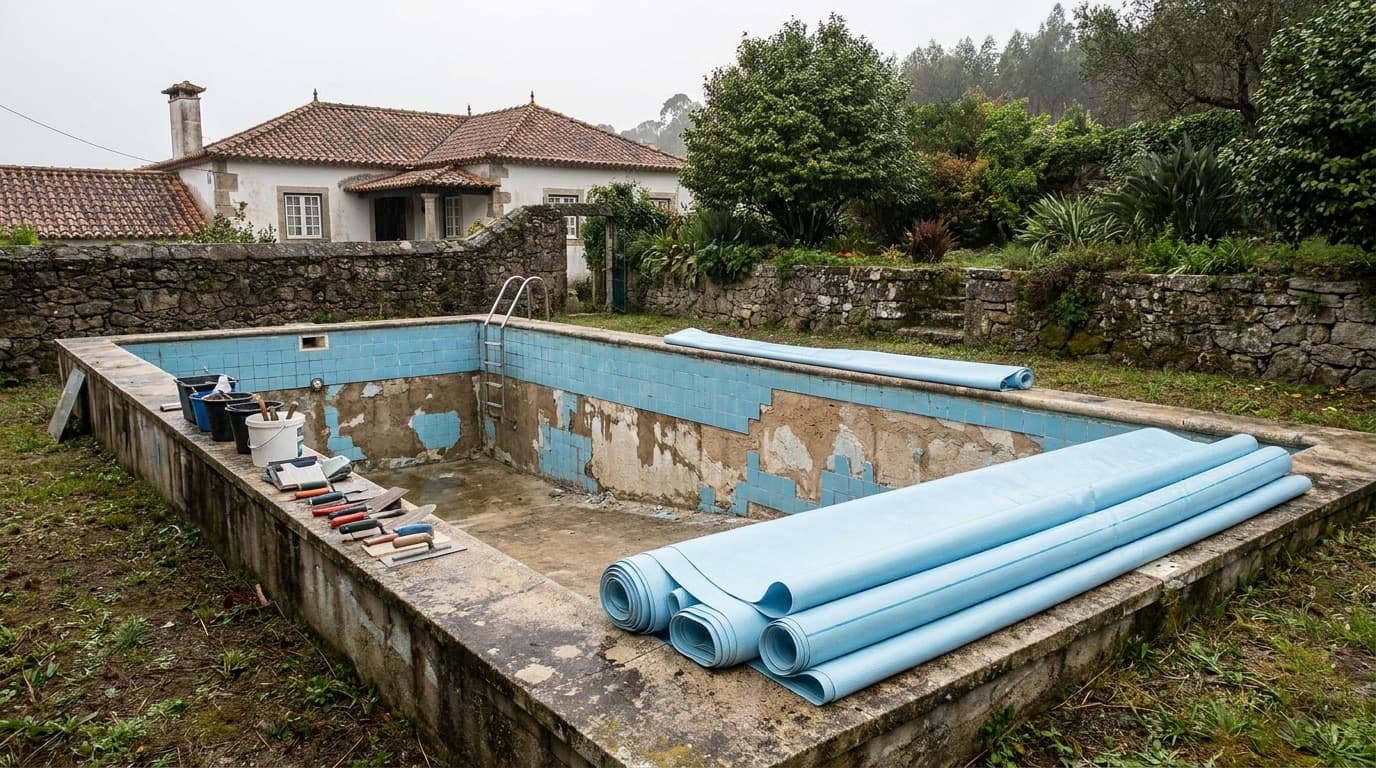
A pool needs renovating when its problems stop being isolated: tiles or mosaic coming away in several places, open grout joints, cracks that return after repair, a faded or torn liner, persistent water loss and an ageing plant room. Many 1980s and 1990s villas around Lisbon have reached this stage.
- Water loss. If the level drops faster than evaporation explains, there is a leak in the structure, the finish or the pipework. Before renovating, you need to know where.
- Loose or broken finish. Loose tiles, falling mosaic and open joints let water reach the concrete.
- Cracks. Hairline cracks in the finish are common; cracks that run through the structure or keep reopening need a technical assessment.
- Worn liner or membrane. Fading, wrinkles, tears and stains that will not shift are signs it has reached the end of its life.
- Limescale and stains. Hard water in many areas leaves deposits along the waterline and in the joints.
- Old equipment. Single-speed pumps, undersized filters and halogen lights use more electricity and chemicals than current equipment.
Should you repair or renovate your pool?
Repair when the problem is localised: a leaking pipe (about €350), a single crack (about €400) or a broken pump (about €400). Renovate when the finish is failing across the whole pool or there are several leaks at once — at that point, patching area by area costs more within a few years.
| Problem | What to do | Who does it | Indicative cost |
|---|---|---|---|
| Leak in a pipe or fitting | Repair | Pools Portugal team | ≈ €350 |
| Single crack in the structure | Repair and monitor | Pools Portugal team (assessment); Network expert if structural | ≈ €400 |
| Broken pump | Replace the pump | Pools Portugal team | ≈ €400 |
| Faded or torn liner | Replace the liner | Network expert | ≈ €2,500 (small pool) |
| Tiles or mosaic coming away in several places | New finish | Network expert | €40 – €120 / m² |
| Several leaks, structural cracks, an old pool | Full renovation | Network expert | €12,000 – €28,000 |
Sources: habitissimo, pool renovation and pool finish price guides (updated 10 Jun 2026); clickpiscina (updated 4 Sep 2026). Approximate figures; the real cost depends on the assessment.
Who does what. Our own team handles small repairs and equipment: the Pools Portugal team fixes leaking pipework and replaces pumps, filters, lighting and automation, as well as looking after maintenance. Full renovations — a new reinforced membrane, new tiles or mosaic, structural repairs — are carried out by experts from the Pools Portugal Network, with our team following the work. See our team's services.
Which pool finish is best?
No single finish is best for every pool. To renovate an old pool with cracks, a reinforced PVC membrane (€40–€120 per m² applied, 15–25 years) is the safest choice because it also waterproofs. For maximum durability, glass mosaic or ceramic tile last 20–50 years but need a sound substrate and their own waterproofing.
| Finish | Indicative price | Lifespan | Look |
|---|---|---|---|
| Reinforced PVC membrane (tela armada) | €40 – €120 / m² applied ¹ | 15 – 25 years | Smooth, plain colours or mosaic print |
| Vinyl liner | ≈ €55 / m² applied ¹ | 10 – 20 years | Smooth, patterned |
| Ceramic tile | €16 – €50 / m² materials and laying ² | 20 – 50 years (grout ≈ 10) | Classic, many formats |
| Glass or porcelain mosaic (pastilha) | €33 – €60 / m² materials and laying ² | 20 – 50 years (grout ≈ 10) | Sheen and depth of colour |
| Quartz / resin | E.g. €2,600 for a 9.2 × 5 m pool ³ | 10 – 20 years | Seamless, mineral |
| Microcement | On quotation | No independent data | Seamless, no joints |
| Paint | The cheapest option | 3 – 7 years | Smooth, matt |
¹ habitissimo, pool finishes (10 Jun 2026): average €80 per m² for pool finishes, range €40–€120 per m². ² habitissimo, pool tiling (10 Jun 2026): materials and labour per m², excluding substrate preparation and waterproofing; a complete tiling job averages €240 per m² (€80–€400 per m²). ³ habitissimo, pool renovation (10 Jun 2026). Lifespans: technical guides published between 2024 and 2025 (see Sources). Real lifespan depends on installation and water treatment.
Typical lifespan of each finish
Reinforced PVC membrane
€40 – €120 / m² · 15 – 25 years
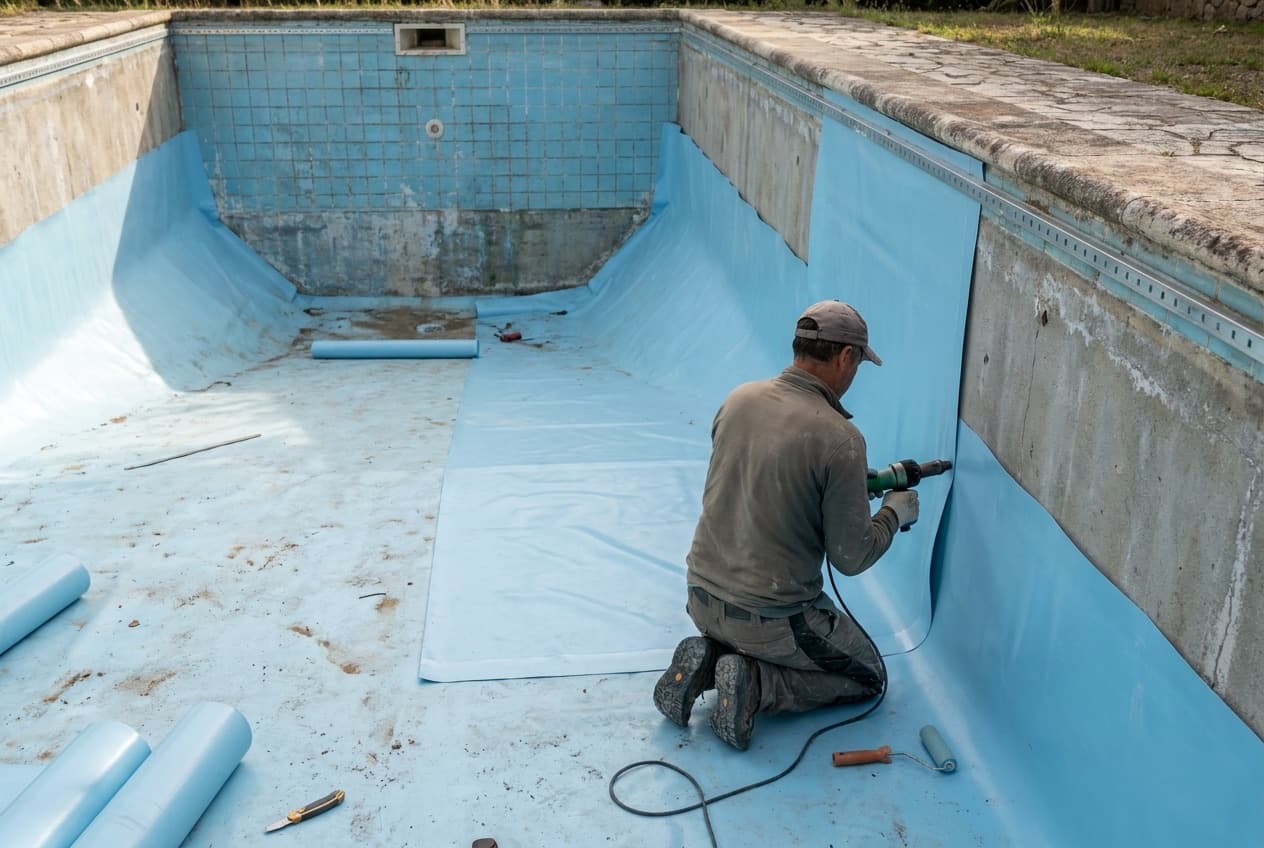
A PVC membrane reinforced with polyester mesh and welded on site. It is finish and waterproofing in one and moves with the structure — which is why it is the usual solution for old pools with cracks.
Glass mosaic
€33 – €60 / m² materials and laying
Absorbs virtually no water and its colour does not fade. It needs a flat substrate, waterproofing underneath and specialist labour; the grout should be checked after about 10 years.
Ceramic tile
€16 – €50 / m² materials and laying
The traditional finish on Portuguese villas. Very durable on a sound substrate; the weak point is the grout. A complete job, including preparation, averages €240 per m².
Vinyl liner
≈ €55 / m² · 10 – 20 years
A vinyl sheet, thinner than a reinforced membrane, common in kit and panel pools. Cheap and quick to replace, but more prone to tears and fading.
Quartz or resin
10 – 20 years
A seamless finish applied over the concrete, with a mineral look. It needs a well-prepared substrate, and there are few specialist applicators in the region.
Paint
3 – 7 years
The cheapest and shortest-lived option: sun and chlorine break it down and it has to be redone every few years. A stopgap, not a renovation.
How is a pool waterproofed?
In a renovation, a pool is waterproofed in one of two ways: with a reinforced PVC membrane, which is itself the water barrier, or with a flexible waterproofing mortar applied to the concrete before the tile or mosaic goes on. Tile and mosaic alone do not waterproof a pool — water passes through the grout.
- Find the leak first. Waterproofing over a broken pipe solves nothing; leak detection comes before any new finish.
- Prepare the substrate. Remove the loose finish, open up and seal the cracks, and level the surface.
- Treat the details. Return inlets, skimmers, lights and steps are where water usually gets through.
- Apply the system. A welded membrane, or waterproofing mortar in layers with reinforcement in the corners.
- Test before finishing. With mortar, fill the pool and check the level before laying tile or mosaic.
Which equipment is worth upgrading during a renovation?
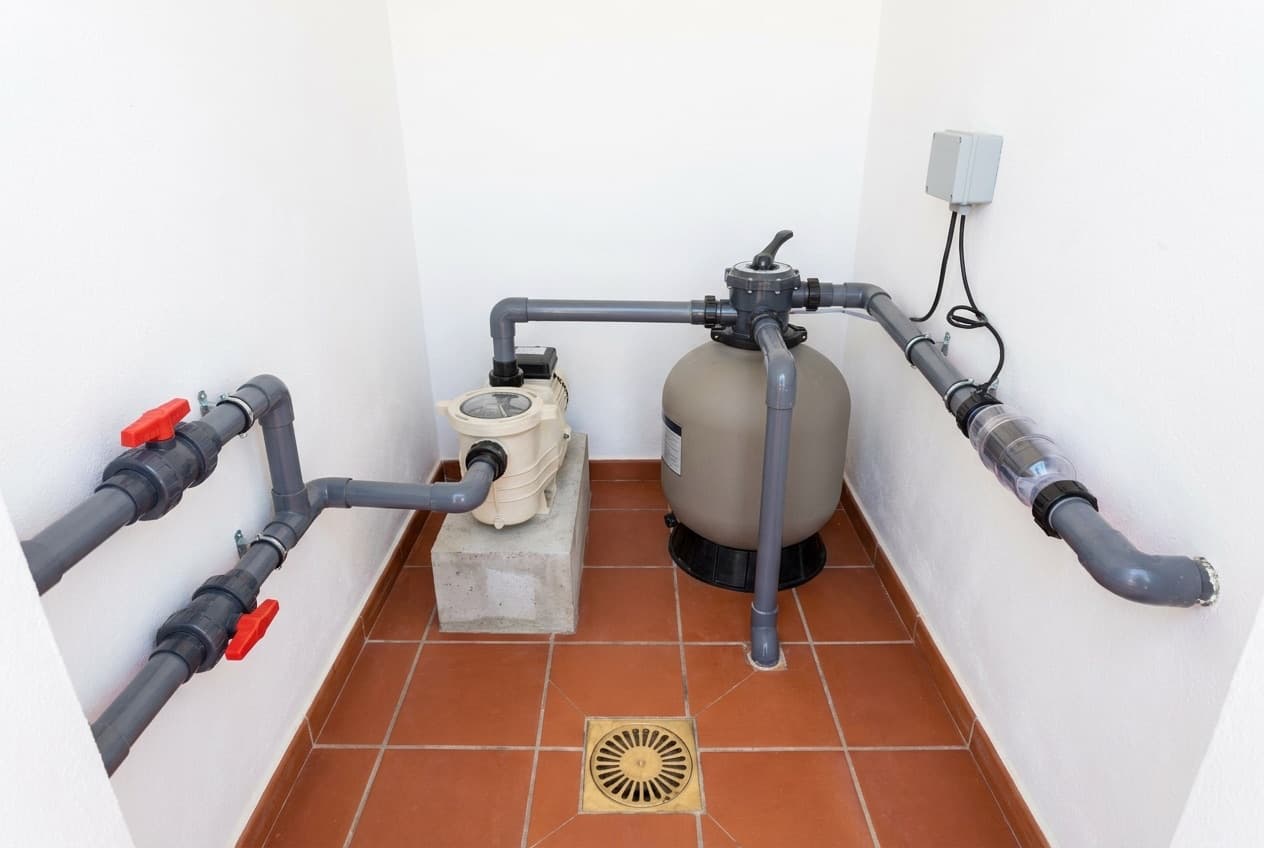
The upgrades with the most impact are a variable-speed pump (lower electricity use), a salt chlorinator (€1,000–€3,500), LED lighting (€300–€2,000) and a heat pump (€2,000–€10,000), which extends the swimming season. With the pool empty, it is also the time to replace pipework and lights.
| Equipment | Indicative cost | What for |
|---|---|---|
| Filter and pump (incl. variable speed) | €1,000 – €3,000 | Less electricity, quieter filtration |
| Pump replacement only | ≈ €400 | Quick repair |
| Salt chlorinator | €1,000 – €3,500 | Automatic disinfection, less chlorine handling |
| LED lighting | €300 – €2,000 | Uses less power than halogen |
| Automatic pH dosing | €500 – €2,000 | Balanced water without daily attention |
| Heat pump | €2,000 – €10,000 | Extends the swimming season |
| Automatic cover | €6,000 – €12,000 | Safety, less evaporation and heat loss |
Sources: Mat Piscinas (3 Apr 2026, figures including VAT); habitissimo, pool renovation (10 Jun 2026); clickpiscina (4 Sep 2026) for the automatic cover. Equipment is installed by our own team.
How much does it cost to renovate a pool?
Around Lisbon, a full renovation of an old pool — finish, coping and plant room — costs €12,000–€28,000. Renewing only the finish and the equipment costs €6,000–€18,000. A new finish on a 3 × 6 m pool can come in at around €2,500.
| Work | Indicative price | Source |
|---|---|---|
| New finish, 3 × 6 m pool | ≈ €2,500 | habitissimo, Jun 2026 |
| Reinforced membrane, 4 × 6 m pool | ≈ €4,500 | habitissimo, Jun 2026 |
| Finish on an 8 × 4 m pool (≈ 68 m²) at €40 – €120 / m² | €2,700 – €8,200 | Calculated from the habitissimo average |
| Full renovation, national average | ≈ €8,000 | habitissimo, Jun 2026 |
| Finish and equipment (1980s and 1990s villas) | €6,000 – €18,000 | clickpiscina, Sep 2026 |
| Full renovation (Cascais, Estoril) | €12,000 – €28,000 | clickpiscina, Sep 2026 |
The 68 m² surface assumes a 32 m² floor and walls with a 1.5 m average depth. Approximate figures; they exclude decking, covers and extensive structural repairs. To compare with a new pool, see the construction price guide.
If the structure has reached the end of its life, replacing the pool can make more sense than renovating it — a fibreglass pool goes in within days once the dig is done. And if you are buying a house with an old pool, factor the renovation into the negotiation: see our guide to buying a property with a pool.
How does a pool renovation work, step by step?
Renewing a pool finish typically takes 15 days to a month on site: assessment, draining, removing the old finish, repairing the substrate, waterproofing, new finish, equipment and start-up. With Pools Portugal, the assessment and start-up are done by our own team and the finish by an expert from the Network.
- 1
Free assessment
Our team visits the pool, tests for leaks, checks the finish, the structure and the plant room, and tells you honestly whether a repair is enough.
- 2
Choice of finish and quote
An expert from the Pools Portugal Network proposes the solution and provides an itemised quote: removal, repairs, waterproofing, finish per m² and coping.
- 3
Draining and stripping
The pool is drained with care (mind the water table) and the loose finish is removed back to a sound substrate.
- 4
Repairs and waterproofing
Cracks sealed, details treated and the waterproofing system applied and tested.
- 5
New finish and coping
Membrane welded, tile or mosaic laid, grout and coping renewed. You receive photos of every stage.
- 6
Equipment, filling and start-up
Our team installs the new equipment, fills the pool, balances the water and shows you how everything works. From then on, you can stay with us on a maintenance plan.
Do you need a permit to renovate a pool in Portugal?
Generally not: conservation works — repairing, restoring or cleaning while keeping the pool as it was built — are exempt from both licence and prior notice (article 6(1)(a) of the RJUE, Portugal's building-permit code). Changing the shape, size or structure counts as alteration or extension works. If in doubt, check with the câmara.
The exemption does not override the municipal master plan or heritage rules: on listed buildings or within their protection zones, even conservation works may need a licence or an opinion (article 4(2)(d)). The consolidated text is published by the Lisbon District Prosecutor's Office (in Portuguese). For new pools or extensions, see the permits and property-tax guide.
When is the best time to renovate a pool?
The best time to renovate a pool is between October and March: the pool is not in use, specialists have more availability outside the high season, and a job of 15 days to a month finishes comfortably before summer. Asking for quotes in May risks losing the swimming season.
If you live outside Portugal, the renovation can be followed remotely, with photos of every stage — see the guide for foreign owners. For an overview of the whole build process, see the pool construction guide.
Frequently asked questions
Which pool finish is best?
It depends on the pool. To renovate an old pool with cracks, a reinforced PVC membrane is the safest choice because it also waterproofs and lasts 15–25 years. Glass mosaic and tile last longer, 20–50 years, but need a sound substrate and their own waterproofing.
How much does a reinforced PVC pool membrane cost per m²?
Pool finishes cost an average of €80 per m² applied, within a range of €40–€120 per m². As a published example, a reinforced membrane on a 4 × 6 m pool cost about €4,500.
How much do pool tiles or glass mosaic cost per m²?
Materials and laying cost about €16–€50 per m² for tile and €33–€60 per m² for mosaic, without substrate preparation. A complete tiling job, including preparation, averages €240 per m², within a range of €80–€400 per m².
How much does it cost to renovate a pool in Portugal?
Around Lisbon, a full renovation of an old pool costs €12,000–€28,000, and renewing only the finish and the equipment €6,000–€18,000. A new finish on a small pool can come in at around €2,500.
How long does a pool renovation take?
Renewing a pool finish typically takes 15 days to a month on site. Extensive structural repairs or replacing the plant room can take longer.
Do I need planning permission to renovate my pool?
Generally not: conservation works that keep the pool as it was built are exempt from prior control under article 6 of the RJUE. Changing its shape, size or structure is different, and listed buildings have stricter rules. Check with the câmara.
Sources
The figures and rules in this guide come from these sources, consulted on the update date shown at the top.
- clickpiscina — How much does it cost to build a pool in Portugal (includes renovation prices, in Portuguese) — updated 4 Sep 2026
- habitissimo — Pool finish prices (in Portuguese) — updated 10 Jun 2026
- habitissimo — Pool tiling prices (in Portuguese) — updated 10 Jun 2026
- habitissimo — Pool renovation prices (in Portuguese) — updated 10 Jun 2026
- Mat Piscinas — How much does a pool cost in Portugal in 2026 (equipment, in Portuguese) — 3 Apr 2026
- Desjoyaux — The different pool coverings and how long they last — 28 Feb 2024
- guide-piscine.fr — How long pool tiles last (in French)
- vvanat — Waterproof pool paint (in French) — 1 Sep 2025
About this guide
Pools Portugal maintains and repairs pools in Greater Lisbon and the Silver Coast with its own team; construction is carried out by vetted specialists from the Pools Portugal Network. We wrote this guide from what we see in the pools we look after and from the public sources cited.
We review prices and rules at least once a year and whenever the law changes. If you spot an error, write to us at admin@poolsportugal.com.
Keep reading
Tell us about your project
We run a free project study, on site or by video call, and a Pools Portugal Network specialist prepares an itemised quote for your plot.
No obligation. We reply within 24 hours, in English or Portuguese.