
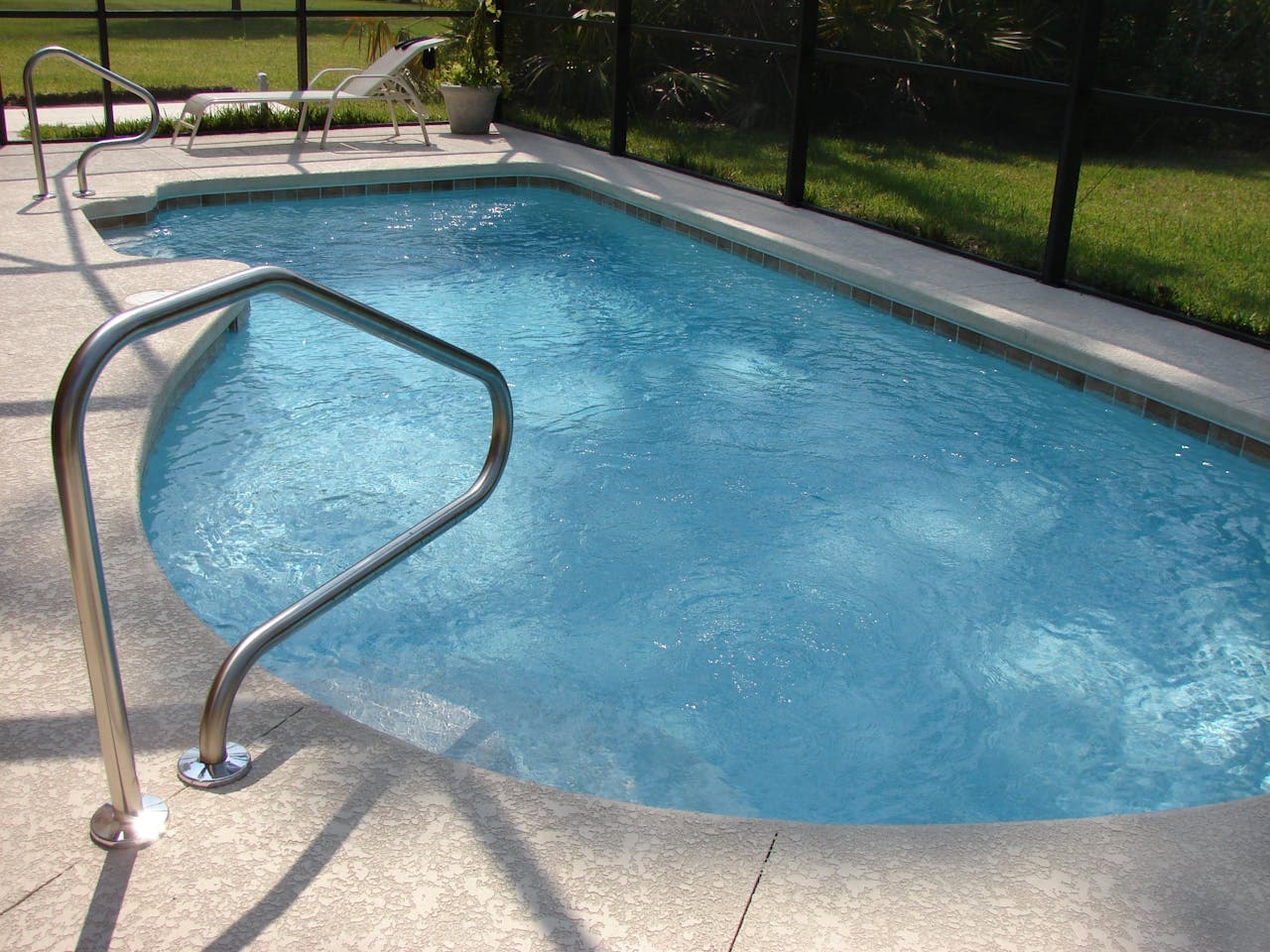
Pool Maintenance
Prevent costly breakdowns and keep your pool running at peak performance with our comprehensive maintenance plans.
Why Regular Maintenance Matters
Comprehensive maintenance to keep your pool equipment running smoothly.
Pool equipment runs for thousands of hours each year. Without regular maintenance, pumps wear out, filters clog, seals crack, and small issues become expensive repairs. Our preventive maintenance plans catch problems early, saving you money and extending the life of your equipment by years.
Our Maintenance Process
Equipment Inspection
We thoroughly inspect your pump, motor, filter, heater, and all connected systems for wear, leaks, or performance issues.
Filter Servicing
We clean or backwash your filter system, check pressure gauges, and replace filter media when needed.
Pump & Motor Check
We verify pump operation, check motor bearings, inspect seals, and ensure optimal flow rates.
Water Chemistry
We test and balance all water parameters to protect both swimmers and equipment from chemical damage.
Report & Recommendations
After each visit, you receive a detailed report of findings, actions taken, and any recommended future work.
What’s Included
- Regular equipment inspections
- Filter cleaning and backwashing
- Pump and motor checks
- Water chemistry monitoring
- Seasonal equipment adjustments
- Preventive maintenance reports
Key Benefits
- Avoid expensive emergency repairs
- Longer equipment lifespan
- Optimized energy efficiency
- Consistent water quality
- Peace of mind year-round
Diagnostic Tools We Use
Our technicians carry professional diagnostic instruments including digital flow meters, pressure gauges, multimeters for electrical testing, and advanced water analysis kits for comprehensive assessments.
Seasonal Maintenance Schedule
Spring: pre-season startup and equipment checks. Summer: weekly monitoring under heavy use. Autumn: winterization prep and leaf protection. Winter: monthly equipment checks and water balancing. We adjust our maintenance to each season.
Expert Tip
Keep a maintenance log of your pool equipment’s age and service history. This helps our technicians spot patterns and predict when parts may need replacement before they fail.
How often a pool in Portugal actually needs maintenance
The honest answer is that it depends on the season and on where the pool is. From June to September, with the water above 26 °C and the pool in near-daily use, pool maintenance becomes weekly work: chlorine burns off fast under the Portuguese summer sun, evaporation shifts the chemical balance, and swimmers bring in organic load every single day.
In spring and autumn, fortnightly is usually enough. Over winter, with the pool closed or barely used, a monthly visit keeps the filtration running and the water stable — far cheaper than recovering a pool in March that has been left to itself since October.
Covered pools, heated pools and heavy-use pools — rentals, condominiums, hospitality — sit outside that rule and get assessed individually. When our team makes the first visit, the plan comes out of the water volume, the filtration type and how the pool is genuinely used, not off a generic schedule.
Coastal pool maintenance: salt, wind and sand
In Cascais, Estoril, Oeiras or Peniche, a pool sits in the salt aerosol the Atlantic pushes inland. Salt settles on grilles, ladder bolts, skimmer lids and the outside of the pump, and it accelerates corrosion on anything metal — including the motor bearings and its electrical connections.
Sand is the second problem. The afternoon nortada carries fine sand past the skimmers and into the pump's pre-filter. A clogged pre-filter makes the pump work against pressure, runs the motor hot and cuts the flow rate — often weeks before anyone notices the water going cloudy.
On the coast our team shortens the interval between backwashes, checks the baskets more closely and rinses exposed components with fresh water. It is simple work, and it is the difference between a motor that lasts eight years and one that lasts three.
Hard water, scale, and what it does to your equipment
Much of the mains water across Greater Lisbon and the Silver Coast is hard. In a pool that shows up first as a rough white line at the waterline, and then as scale inside salt chlorinator cells, heat pump exchangers and the pipework itself.
Calcium hardness is the reading almost nobody takes at home, and it causes the most expensive damage. A scaled salt cell stops producing chlorine, which leads owners to conclude the unit has failed when it actually needs descaling — and a heat pump with a scaled exchanger burns more electricity to deliver less heat.
So regular maintenance measures hardness and alkalinity, not just chlorine and pH, and acts before scale takes hold. Descaling a cell is routine. Replacing a destroyed one is not.
What our team measures on every visit
Every visit runs the same sequence of checks, so the readings are comparable over time: free and total chlorine, pH between 7.2 and 7.6, total alkalinity between 80 and 120 ppm, calcium hardness, and cyanuric acid — the stabiliser that, once it accumulates, locks up the chlorine and is one of the commonest reasons a pool turns green while the test still shows chlorine present.
On the mechanical side we check filter pressure against the clean baseline recorded after the last backwash, the skimmer basket and pump pre-filter, the water level relative to the skimmer mouth, motor noise and temperature, union seals, and the state of the timer or automation.
We brush the waterline, where oils and biofilm build up before any algae is visible, and check the main drain and returns. The visit ends with a written record of the readings and the work done.
That record is what turns a snapshot into a trend. Filter pressure creeping up month after month tells us to change the media before the pump suffers; chlorine demand that climbs for no obvious reason is usually the first sign of something you cannot see in the water yet.
Staying on a plan costs less than recovering the pool
A pool left for two or three weeks in August is not just dirty — it is out of balance. Recovery from there is no longer one visit: it is shock treatment, several backwashes, days of continuous filtration and often flocculant. And the pool is unusable in exactly the week you wanted it.
The same goes for the equipment. A weeping mechanical seal is a cheap part while it is still just a seal; left dripping onto the motor, it stops being one. Most of the emergency repairs we get called out to started as a symptom that was visible months earlier.
That is why preventive maintenance is sold as a plan rather than a one-off call-out. The value is in someone competent looking at the pool regularly, not in someone showing up once the problem has already arrived.
Maintenance for rentals and for owners who are not here year-round
A large share of the pools we look after belong to owners who spend part of the year outside Portugal, or who let the house to guests. That adds a requirement: the pool has to be ready on specific dates, and the owner has to know what is happening without being there.
We report after every visit, send photos whenever there is something to flag, coordinate with whoever handles the house management or the changeover cleans, and match the schedule to occupancy — tighter through guest weeks, spaced out when the house is empty.
Our team works in Portuguese and English, which in practice means you can handle all of it in writing, in your own language, from wherever you are.
Frequently Asked Questions
What does a maintenance plan include?
Our plans cover regular inspections, filter maintenance, water balancing, and equipment checks to prevent costly repairs.
Can I combine maintenance with cleaning?
Absolutely! Most clients bundle cleaning and maintenance for comprehensive pool care at a better rate.
Do you service all pool types?
Yes, we service concrete, vinyl, fiberglass, and infinity pools of all sizes.
How often do you visit for maintenance?
Our standard plans include monthly visits, but we offer bi-weekly or weekly maintenance for larger or heavily used pools.
Will you notify me if something needs urgent attention?
Yes, if we detect any urgent issue during a maintenance visit, we’ll contact you immediately with a diagnosis and recommended action.