
Pool types
Infinity pools in Portugal: what one costs and how an infinity edge works
2026 prices, the water circuit explained piece by piece, the ground and structure an infinity edge needs, what it costs to run, which permit applies and how to make the drop side safe.
 Pools Portugal teamPool construction and maintenanceUpdated 9 min read
In this article
- 1.How much does an infinity pool cost in Portugal?
- 2.How does an infinity pool work?
- 3.How big is the balance tank and what equipment is needed?
- 4.Can an infinity pool be fibreglass, or does it have to be concrete?
- 5.What kind of plot does an infinity pool need?
- 6.Does an infinity pool cost more to run?
- 7.Do you need a permit to build an infinity pool in Portugal?
- 8.Is the drop side of an infinity pool safe?
- 9.How does an infinity pool project run?
- 10.Frequently asked questions
- 11.Sources
Key points
- Around Lisbon, an 8 × 4 m reinforced-concrete infinity pool costs roughly €45,000–€75,000, and a 10 × 5 m one roughly €70,000–€150,000.
- Simple projects, with a single infinity edge on a naturally sloping plot, start at around €25,000–€30,000; an infinity edge typically costs 20 % to a third more than an equivalent conventional pool.
- Water spills over a wall levelled to the millimetre into a catch gutter, drains by gravity to a balance tank holding at least 10 % of the pool volume, and is pumped back through the filter.
- An infinity pool uses more electricity and more water than a conventional pool, because the pump runs whenever the edge is flowing and the falling sheet of water evaporates more.
- Like any pool attached to a house, an infinity pool usually only needs a prior notification (comunicação prévia) to the câmara; in protected areas such as the Sintra-Cascais and Arrábida natural parks a full licence may be required.
How much does an infinity pool cost in Portugal?
Around Lisbon in 2026, an 8 × 4 m reinforced-concrete infinity pool costs roughly €45,000–€75,000 turnkey, and a 10 × 5 m one roughly €70,000–€150,000. Simple projects, with a single edge on a plot with a natural slope, start at around €25,000–€30,000, before rock or heating.
| Project | Indicative range | Source |
|---|---|---|
| Simple infinity pool, one edge | from €25,000 – €30,000 | Builders operating in Portugal |
| Infinity pool (general range) | €25,000 – €60,000 | idealista, Jul 2026 |
| 8 × 4 m in concrete, Greater Lisbon | €45,000 – €75,000 | Pools Portugal cost guide |
| 10 × 5 m in concrete, Greater Lisbon | €70,000 – €150,000 | Pools Portugal cost guide |
| Premium or overflow pool | €60,000 – €150,000 or more | Portuguese builder, Apr 2026 |
| Several edges, spa and automation | €80,000 or more | Portuguese builder |
How to read these figures: approximate figures for a reinforced-concrete pool with filtration and a balance tank. They exclude rock, unusual retaining walls, heating and landscaping. Sources do not always state their VAT basis; pool construction pays the standard 23 % rate. Reviewed 8 October 2026. Compare with other pool types in the pool cost guide.
8 × 4 m pool: turnkey price by method
Compared with a conventional pool of the same size, an infinity edge costs at least 20 % more according to a Spanish quotes portal, and about a third more according to a manufacturer operating in Portugal. The difference pays for the overflow wall, the catch gutter, the balance tank, a bigger pump and far more calculation and precision on site.
How does an infinity pool work?
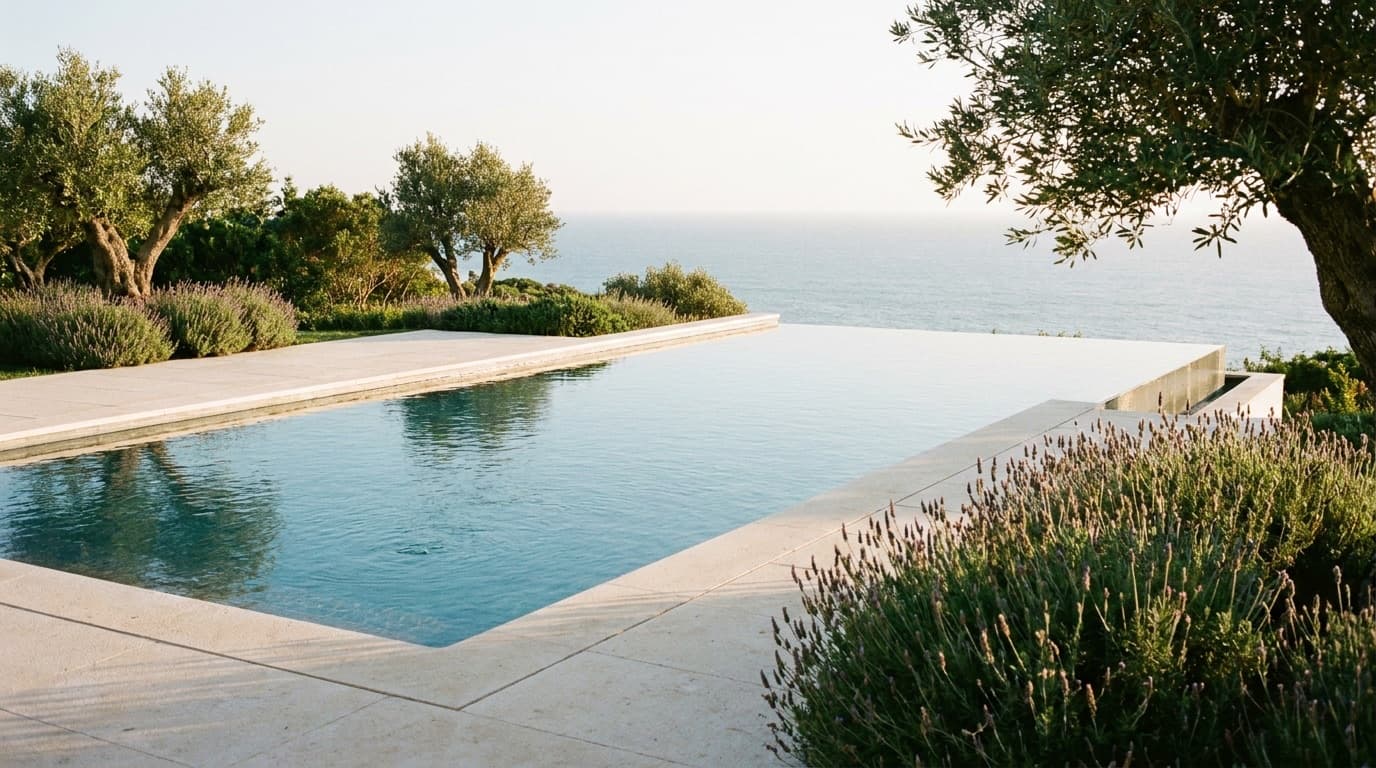
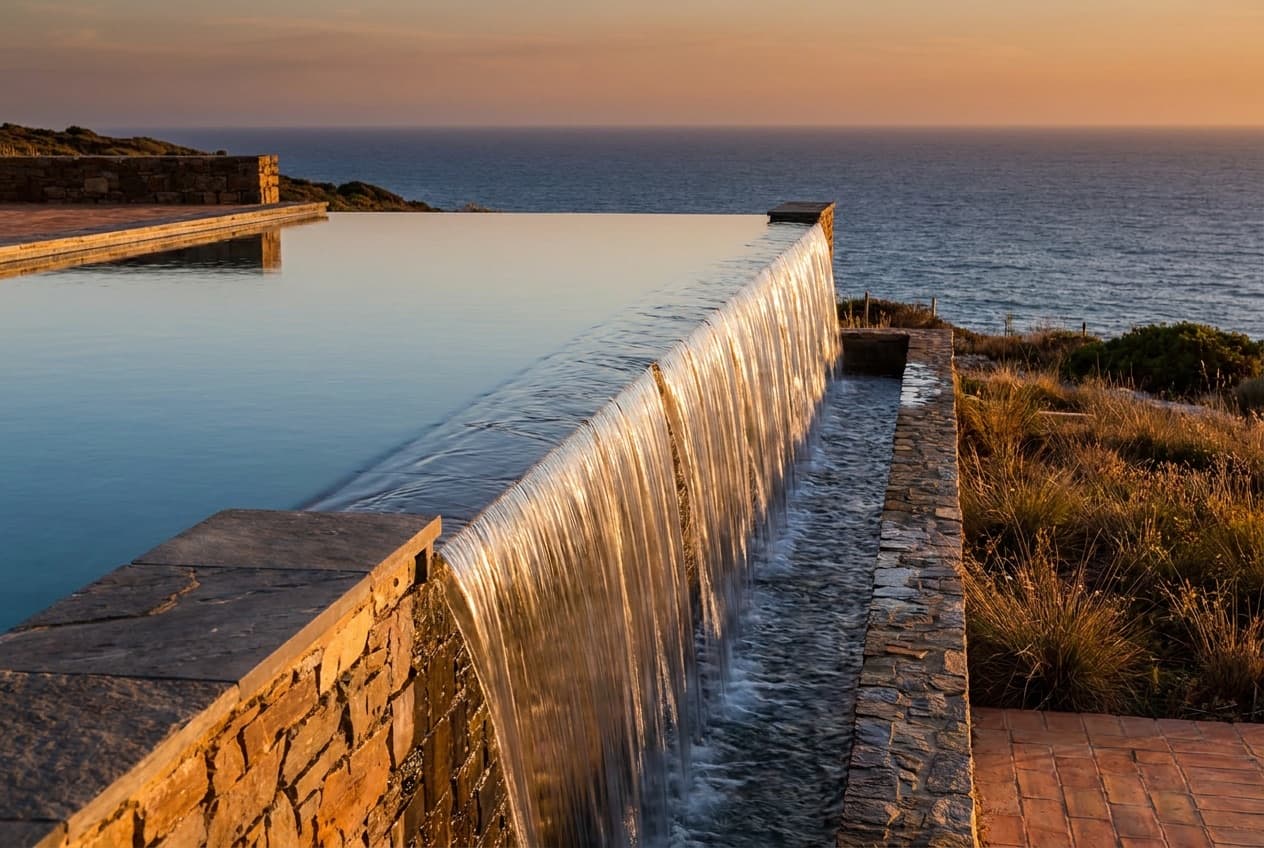
In an infinity pool, the water level sits just above an overflow wall. Water spills in a thin sheet into a hidden catch gutter, drains by gravity to a balance tank, and the pump returns it to the pool through the filter. From inside the pool, the water appears to merge with the horizon.
- Overflow wall (weir). The top of the wall on the view side sits a few millimetres below the water level and must be perfectly level — one Portuguese builder works to tolerances under 2 mm.
- Catch gutter. It runs the full length of the infinity edge, below the wall, and collects the water that spills over.
- Balance tank. Water drains by gravity into this reservoir, which absorbs the water displaced when someone gets in and gives it back when they get out.
- Pump and filter. The pump draws from the tank, sends the water through the filter and disinfection, and returns it through the return jets, keeping the edge flowing.
- Automatic top-up. A level sensor in the tank opens the mains supply when evaporation lowers the level, so the pump never runs dry.
- 1Lowered edge: water spills over in a thin sheet
- 2Catch gutter below the edge
- 3Buried balance tank
- 4Automatic water top-up valve
- 5Pump and filter
- 6Back to the pool through the return inlets
How big is the balance tank and what equipment is needed?
The balance tank of an infinity pool should hold at least 10 % of the pool volume: for an 8 × 4 m pool with an average depth of 1.4 m, about 45 m³, that means roughly 4.5 m³. The final sizing, together with the gutter and pump, is done by the pool designer.
| Component | Job | What to check |
|---|---|---|
| Overflow wall | Creates the sheet of water | Level tolerance and top material (stone, stainless steel, polished concrete) |
| Catch gutter | Collects the spill | Wide enough that water does not overshoot it |
| Balance tank | Absorbs changes in volume | At least 10 % of the pool volume, plus the gutter |
| Circulation pump | Keeps the edge flowing | Flow rate calculated for the edge length; ideally variable-speed |
| Automatic top-up | Replaces evaporation | Level sensor in the tank and dry-run protection |
| Overflow drain | Gets rid of rainwater | Connection to the plot's drainage |
Sources: habitissimo.es (Jun 2026) for the 10 % rule; a Portuguese builder for the level tolerance. The 45 m³ volume is calculated: 8 × 4 × 1.4 m.
Infinity edge or overflow pool? With an infinity edge, water spills over one or more sides into a gutter below, on the view side. With an overflow pool (also called a deck-level or Finnish-gutter pool), water spills all round the perimeter into a grille flush with the paving. Both need a balance tank; only the first creates the horizon effect.
Can an infinity pool be fibreglass, or does it have to be concrete?
Almost all infinity pools are built in reinforced concrete, because the overflow wall must be level to the millimetre and hold back the ground on the drop side. Polyester overflow shells exist, but in Portugal a fibreglass pool with a true infinity edge is rare.
In concrete, the shape and length of the edge are designed around the plot and the view. The trade-off is time: a concrete pool takes 8–12 weeks on site, and an infinity edge, with its tank and walls, usually longer. An 8 × 4 m fibreglass pool without an infinity edge costs €20,000–€32,000 and goes in within days.
What kind of plot does an infinity pool need?
The ideal plot has a natural slope on the view side, so the balance tank sits below the pool with little digging. On flat ground, the pool can be raised with the tank built into the structure. Either way, the reinforced-concrete structure needs a structural design by an engineer.
Sintra and the hills
Slopes looking out to sea or over the hills are perfect for an infinity edge, but granite can add €3,000–€10,000 to the dig. Part of the municipality lies in the Sintra-Cascais Natural Park.
Arrábida, Sesimbra and Setúbal
Views over the Sado estuary and the sea, often on limestone rock. Excavation and retaining walls weigh on the budget, and the Arrábida Natural Park has its own rules.
Cascais and the coast
The nortada wind at Guincho speeds up evaporation and blows debris into the gutter. Prefer an edge facing south or sheltered from the north wind, and 316 stainless fittings because of the salt air.
Silver Coast and Foz do Arelho
Views over the Óbidos lagoon and the sea, but a high water table: a balance tank buried below the pool needs drainage and a design that resists groundwater uplift.
Does an infinity pool cost more to run?
Yes. An infinity pool uses more electricity, because the pump runs whenever the edge is flowing, and more water, because the falling sheet and the gutter evaporate more than still water. A conventional pool costs €600–€1,600 a year to run; an infinity pool costs more.
- Variable-speed pump. Cuts consumption when the pool is not in use; ask the designer for the expected hourly consumption.
- Scheduled overflow. Ask whether the system lets you switch the infinity effect on only when you are using or looking at the pool.
- Evaporation and wind. On exposed sites such as Cascais and Guincho, top-up water goes up. A pool cover reduces losses, but it does not cover the gutter.
- Heating. A heated infinity pool loses more heat through the moving water; size the heat pump with that loss in mind.
- Cleaning the gutter and tank. Leaves and sand collect in the gutter; our team includes the gutter and balance tank in maintenance.
Do you need a permit to build an infinity pool in Portugal?
Usually not a full licence: an infinity pool attached to a house follows the same rules as any pool and needs a prior notification (comunicação prévia) to the câmara (RJUE, art. 4(4)(j)). In protected areas — the Sintra-Cascais and Arrábida natural parks, REN or RAN land — a licence and outside opinions may be required.
Since 1 October 2026, under Decree-Law 108/2026, works can start once the prior notification is submitted, the fees are paid and the start of works is notified. For an infinity edge, the file usually includes the structural design of the walls and tank. The permits guide explains it all, municipality by municipality.
Is the drop side of an infinity pool safe?
The infinity side is a drop: seen from outside, the wall and gutter form a step that can be high on a slope. A safe infinity pool keeps the drop side out of children's reach, has a guard rail or fence on the lower level, non-slip paving and a wall top that is not used as a walkway.
- Do not use the wall as a walkway. The top is wet and slippery; design access to the pool from the other sides.
- Protect the lower level. If the gutter faces a garden or terrace, fit a guard rail or fence that stops children climbing up.
- Grilles on the suction points. Suction outlets in the tank and the pool should have anti-entrapment grilles.
- Safety cover. An automatic cover protects the pool when it is not in use, but it does not cover the gutter — the fence is still needed.
How does an infinity pool project run?
An infinity pool project with the Pools Portugal Network starts with a survey of the plot and the view, moves through the architectural and structural design and the prior notification, and only then to the build. A concrete infinity pool takes longer than the 8–12 weeks of a conventional concrete pool.
- 1
Free study and survey
1–2 weeksSite visit or video call, ground levels, the direction of the view and the wind, machine access and the position of the balance tank.
- 2
Architectural and structural design
2–4 weeks +Design of the edge, hydraulic calculation of the overflow, sizing of the tank and pump, and structural design of the walls by an engineer.
- 3
Prior notification or licence
1–3 weeksSubmission to the câmara, payment of fees and notice of the start of works. In protected areas, outside opinions can take considerably longer.
- 4
Construction
8–12 weeks +Excavation, structure, tank, overflow wall, waterproofing, finish and hydraulics. The level of the wall is checked before the finish goes on.
- 5
Start-up by our team
1 weekFilling, tuning the overflow along the whole edge, balancing the water and a walk-through of the equipment. The same team then looks after maintenance.
If you live abroad, we follow the build with weekly reports — see the guide for foreign owners. For the full construction process, go back to the pool construction guide.
Frequently asked questions
How much does an infinity pool cost in Portugal?
Around Lisbon, an 8 × 4 m reinforced-concrete infinity pool costs roughly €45,000–€75,000, and a 10 × 5 m one roughly €70,000–€150,000. Simple projects with a single edge on a sloping plot start at around €25,000–€30,000.
How much more does an infinity edge cost than a normal pool?
Typically at least 20 % and up to about a third more than a conventional pool of the same size, because of the overflow wall, the catch gutter, the balance tank and a bigger pump.
How does the balance tank work?
Water spilling into the gutter drains by gravity into the balance tank, which absorbs the changes in volume as people get in and out. The pump draws from the tank and returns the water to the pool through the filter. The tank should hold at least 10 % of the pool volume.
Can you build an infinity pool on flat ground?
Yes, by raising the pool above ground level and building the balance tank into the structure. It costs more than on a naturally sloping plot, where the tank fits below the pool with little digging.
Does an infinity pool need planning permission in Portugal?
Attached to a house, it usually only needs a prior notification (comunicação prévia) to the câmara, like any pool. In protected areas such as the Sintra-Cascais and Arrábida natural parks, REN or RAN land, a licence and opinions from other bodies may be required.
Does an infinity pool use more water?
Yes. The falling sheet of water and the gutter increase evaporation, especially on windy sites such as Cascais, and a cover does not protect the gutter. The automatic top-up replaces the lost water so the pump never runs dry.
Sources
The figures and rules in this guide come from these sources, consulted on the update date shown at the top.
- idealista/news — Building a pool: what a swim at home really costs (in Portuguese) — 1 Jul 2026
- Mat Piscinas — How much does a pool cost in Portugal in 2026 (in Portuguese) — 3 Apr 2026
- Waterair — Infinity pools (in Portuguese)
- JCL Piscinas & Construções — Infinity pools in Portugal (in Portuguese)
- habitissimo.es — Cost of building an overflow pool (in Spanish) — updated 10 Jun 2026
- Consolidated RJUE (planning and building code) — Lisbon District Attorney General's Office (in Portuguese)
About this guide
Pools Portugal maintains and repairs pools in Greater Lisbon and the Silver Coast with its own team; construction is carried out by vetted specialists from the Pools Portugal Network. We wrote this guide from what we see in the pools we look after and from the public sources cited.
We review prices and rules at least once a year and whenever the law changes. If you spot an error, write to us at admin@poolsportugal.com.
Keep reading

Tell us about your project
We run a free project study, on site or by video call, and a Pools Portugal Network specialist prepares an itemised quote for your plot.
No obligation. We reply within 24 hours, in English or Portuguese.