
Pool types
Fibreglass pools in Portugal: what one costs installed, sizes and installation (2026)
Installed and shell-only prices, the sizes you can buy in Portugal, how a fibreglass pool goes in within days, what to check in your garden before you order, and the risks to avoid — from the crane to osmosis.
 Pools Portugal teamPool construction and maintenanceUpdated 10 min read
In this article
- 1.How much does an installed fibreglass pool cost in 2026?
- 2.What is included in the price of a fibreglass pool?
- 3.What sizes of fibreglass pool can you buy in Portugal?
- 4.How is a fibreglass pool installed, step by step?
- 5.Can a lorry and crane reach your garden?
- 6.Fibreglass or concrete pool: which is better?
- 7.What is osmosis in a fibreglass pool and how do you avoid it?
- 8.Is a fibreglass pool easier to maintain?
- 9.Where does a fibreglass pool make sense around Lisbon and the Silver Coast?
- 10.Frequently asked questions
- 11.Sources
Key points
- Around Lisbon, an 8 × 4 m fibreglass pool costs roughly €20,000–€32,000 installed and a 6 × 3 m one roughly €16,000–€24,000, turnkey.
- The fibreglass shell alone costs roughly €6,000–€17,500 from a Portuguese retailer; excavation, transport, crane, equipment and coping make up the rest.
- The most common shells are 7–9 m long and leave the factory in one piece; anything over about 10 m is rare, because the shell travels whole by road and goes in by crane.
- Once the hole is dug, installation typically takes 2–5 days, and the whole project around 10–20 days to the first swim.
- A well-installed fibreglass pool lasts 25–30 years or more; the main risk with a poor-quality shell is osmosis, which shows up as blisters under the gelcoat.
How much does an installed fibreglass pool cost in 2026?
Around Lisbon in 2026, an 8 × 4 m fibreglass pool costs roughly €20,000–€32,000 installed, turnkey, and a 6 × 3 m one roughly €16,000–€24,000. The shell alone costs roughly €6,000–€17,500; the rest is excavation, the crane, equipment and coping.
| Size | Shell only | Installed, turnkey |
|---|---|---|
| 5–5.5 m long | approx. €8,000 – €10,500 | no reliable data ¹ |
| 6 × 3 m | — | €16,000 – €24,000 |
| 8 × 4 m (8–8.5 m shells) | €11,500 – €12,900 | €20,000 – €32,000 |
| 10 m long | approx. €14,500 | rare at this size |
How to read these figures: shell prices from a Portuguese online retailer's catalogue, checked on 8 October 2026 (the retailer does not say whether they include VAT). Installed prices include filtration, basic lighting and coping on normal ground, triangulated from clickpiscina (Sep 2026) and idealista (Jul 2026). ¹ We found no reliable published installed price for 5 × 3 m: expect the bottom of the 6 × 3 m range, because excavation, crane and plant room cost almost the same. More in the pool cost guide.
8 × 4 m pool: turnkey price by method
By municipality, published prices for an installed 7–9 m fibreglass pool run from €16,000–€32,000 in Lisbon, €18,000–€35,000 in Cascais, €18,000–€34,000 in Oeiras and Sintra and €16,000–€30,000 in Almada (clickpiscina, September 2026). There is no reliable published data for the Silver Coast or Setúbal.
What is included in the price of a fibreglass pool?
The shell is less than half of the final price. For an installed 8 × 4 m fibreglass pool, the quote adds up the shell, excavation and spoil removal, transport and crane, the concrete base, plumbing and filtration equipment, backfill and coping. Always ask for each line separately.
| Quote line | Typical range | Note |
|---|---|---|
| Fibreglass shell (the shell only) | €6,000 – €17,500 | Depends on model, length and steps |
| Excavation and spoil removal | €1,000 – €8,000 | More on rock or with tight access |
| Rock surcharge | €1,500 – €10,000 | Mostly in Sintra and around Arrábida |
| Filter and pump | €1,000 – €3,000 | Plus the plant room |
| Transport and crane | ask for the figure | Sometimes included with the shell, sometimes not |
| Base, backfill and coping | ask for the figure | Varies with the coping material |
Sources: a Portuguese online retailer's shell catalogue (Oct 2026); clickpiscina (Sep 2026); idealista (Jul 2026); a Portuguese builder (Apr 2026). The same extras appear in the pool cost guide.
A "fibreglass pool" price without installation is not comparable. Many listings show only the shell, or a kit with a plant room, at €5,000–€8,000. Without excavation, crane, base, backfill and coping, that figure is a long way from the cost of a pool you can swim in.
What sizes of fibreglass pool can you buy in Portugal?
Fibreglass shells sold in Portugal run from about 4 m to 10 m long, typically 1.4–1.5 m deep. The most popular are 7–9 m, in a single piece. Anything over about 10 × 4 m is rare: the shell travels whole by road and is lifted in by crane.
| Shell length | Typical use | Shell price |
|---|---|---|
| 4–4.5 m | Cooling off in a small garden | approx. €7,700 |
| 5–5.5 m | Small family, terrace or courtyard | approx. €8,000 – €10,500 |
| 8–8.5 m | The most requested family size (8 × 4 m) | €11,500 – €12,900 |
| 10 m | Swimming a few strokes in a row | approx. €14,400 |
Catalogue prices from a Portuguese online retailer, shell only, checked on 8 October 2026. One Portuguese manufacturer lists its 8 × 4 m shell at 1.50 m deep with a 15-year warranty. Exact widths and depths vary by model.
If you need more than 10 m, a free-form shape or an infinity edge, fibreglass stops being the natural choice and a reinforced-concrete pool makes more sense.
How is a fibreglass pool installed, step by step?
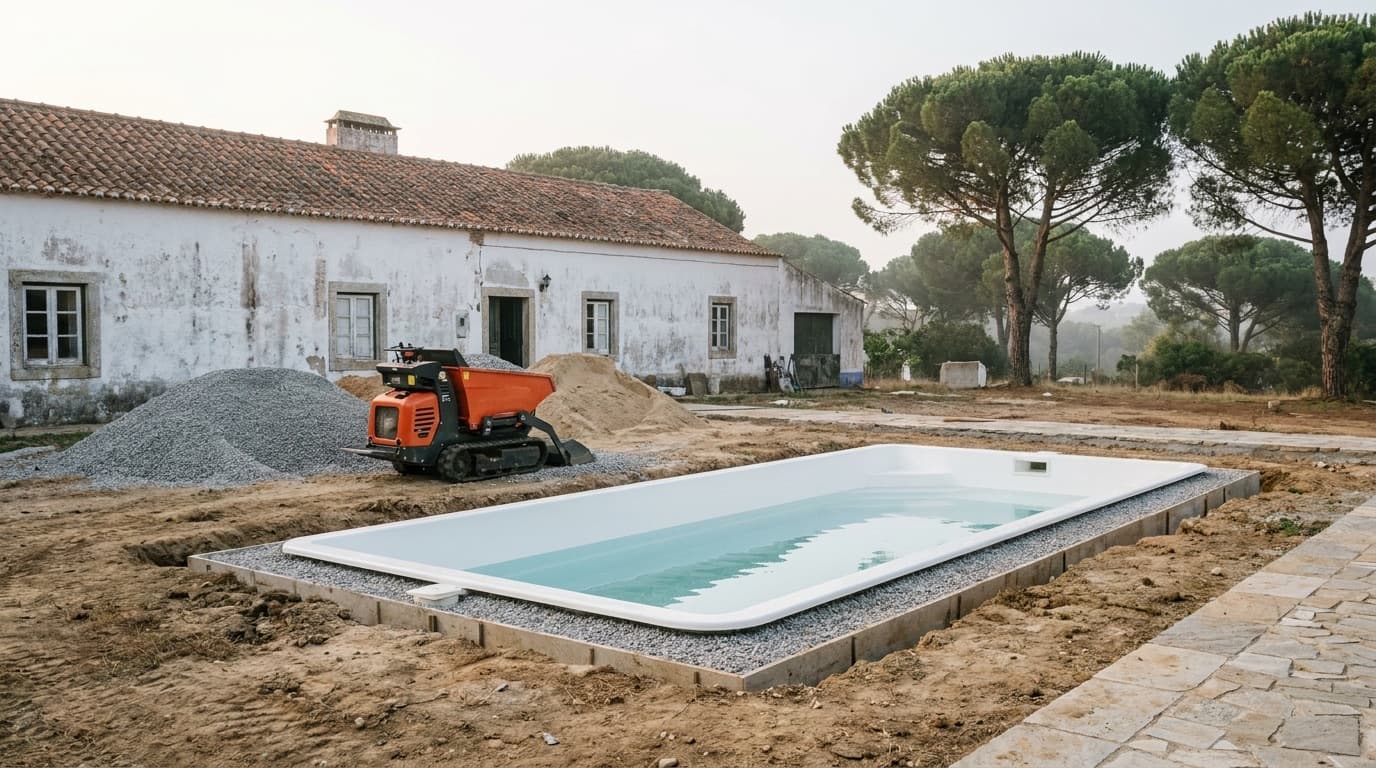
Once the hole is dug, an expert from the Pools Portugal Network installs a fibreglass pool in 2–5 days: a level concrete base, crane placement, plumbing, and backfill carried out while the pool fills with water. From the start of works to the first swim takes around 10–20 days.
- 1
Setting out and excavation
1–3 daysThe position is marked out and a hole slightly larger than the shell is dug. In sandy soil, as on the south bank of the Tagus, the sides need shoring so they do not collapse.
- 2
Level concrete base
1–2 daysA concrete slab of about 10 cm, perfectly level, with an optional layer of fine sand on top. A badly levelled base shows up later as crooked steps or a waterline that does not run parallel to the coping.
- 3
Crane placement
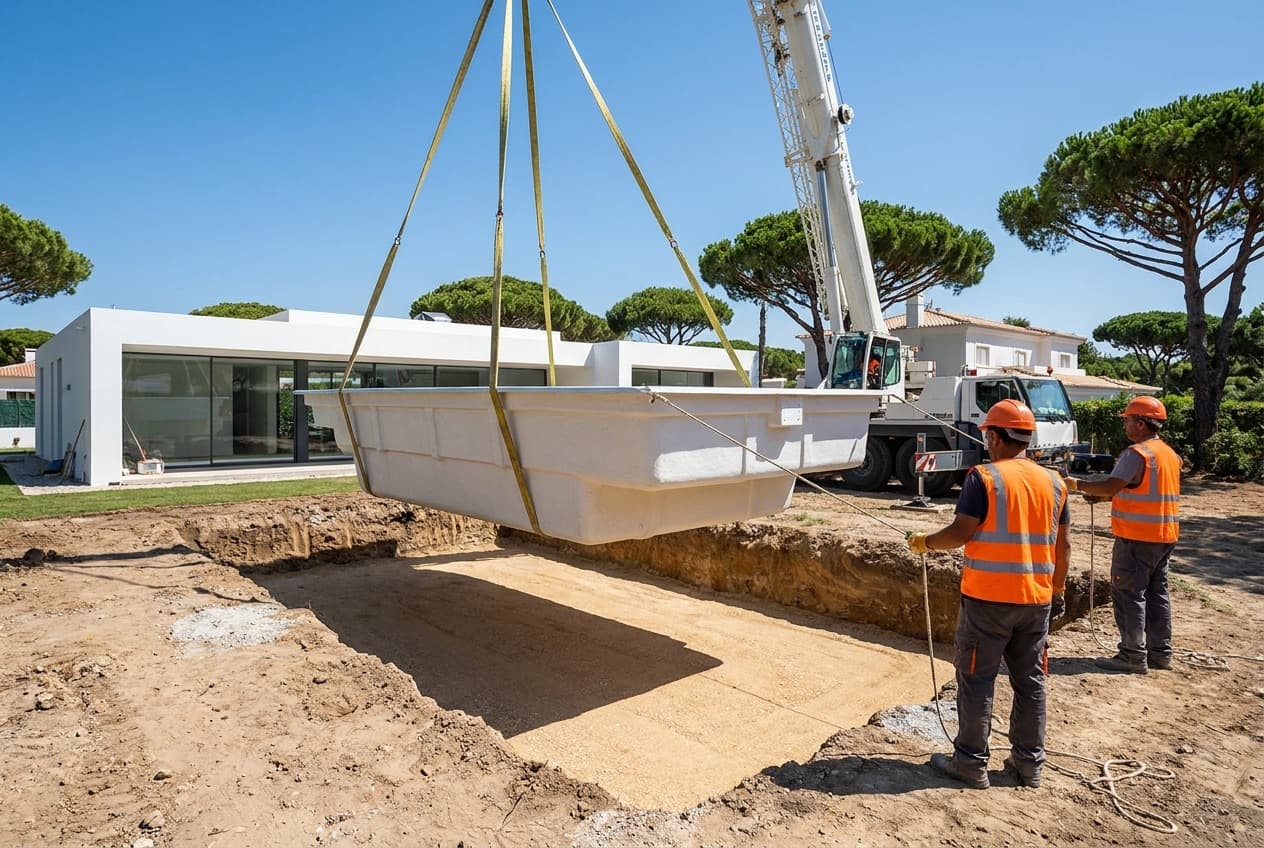
half a dayThe crane lorry sets the shell into the hole. The level is checked in every direction and the first 10 cm of water goes in so the shell settles.
- 4
Plumbing and pressure test
1–2 daysThe main drain, skimmers, return jets and lights are connected to the plant room, and the pipework is pressure-tested before it is buried.
- 5
Backfill and filling together
1–2 daysThe gap around the shell is filled with a dry sand-and-cement mix, in layers, at the same pace as the water rises inside the pool. The pressure inside balances the pressure outside, so the walls do not deform.
- 6
Ring beam and coping
3–7 daysA concrete collar around the top of the shell, then the stone coping and paving laid to fall away from the pool.
- 7
Start-up by our team
1 weekBalancing the water chemistry, setting up the pump and filter, and a walk-through of the equipment for the owner. The same team then looks after maintenance.
- 1Excavation, slightly larger than the shell
- 2Level base (compacted gravel or lean concrete)
- 3One-piece fibreglass shell
- 4Side backfill (gravel or sand-cement)
- 5Water kept level with the backfill to balance pressure
- 6Ring beam and coping
- 7Pipework to the plant room
Can a lorry and crane reach your garden?
Access decides whether a fibreglass pool is possible at all. An 8 × 4 m shell arrives whole on a lorry, and the crane has to be able to set it down in the hole. In houses you can only enter through the front door, as in parts of old Lisbon, fibreglass is not an option.
- Street width and surface. The lorry has to park close to your wall on firm ground.
- Crane reach. Measure the distance from the street to the centre of the hole; the further it is, the bigger and dearer the crane.
- Overhead cables and trees. Power and phone lines or large canopies in the crane's path can stop the lift.
- Side access. Even with a crane, the digger has to get into the garden; measure the narrowest passage.
- Street occupation. If the lorry blocks the road, the câmara (town hall) may require prior authorisation.
Fibreglass or concrete pool: which is better?
Fibreglass is cheaper and far quicker in standard sizes up to about 9 m; reinforced concrete allows any shape, size or infinity edge and lasts 30–50 years. For an 8 × 4 m pool in a garden with good access, fibreglass is usually the more economical choice.
| Criterion | Fibreglass | Reinforced concrete |
|---|---|---|
| Turnkey price, 8 × 4 m | €20,000 – €32,000 | €30,000 – €50,000 |
| Build time | 10–20 days in total | 8–12 weeks |
| Shape and size | Catalogue models, up to about 10 m | Any shape and size |
| Infinity edge | Rare | Yes |
| Lifespan | 25–30 years or more | 30–50 years |
| Surface | Smooth, less algae | Depends on the finish |
| Crane access | Essential | Not needed |
Sources: clickpiscina (Sep 2026), idealista (Jul 2026), a Portuguese builder (May 2025), habitissimo (Jun 2026). Concrete prices from the pool cost guide.
What is osmosis in a fibreglass pool and how do you avoid it?
Osmosis is the appearance of blisters under the gelcoat of a fibreglass shell, caused by water passing through the gelcoat and reacting with flaws in the laminate. It is a manufacturing defect, not a maintenance one, and may only appear after several seasons. It is treated by draining, drying, sanding and applying new gelcoat.
- Typical sign: blisters scattered over the submerged walls that release a sticky, acidic-smelling liquid when pierced. A dry, hollow blister points instead to local delamination.
- Severity: a few isolated blisters do not threaten watertightness straight away; progression is the problem. Photograph the walls season to season.
- Treatment: drain, let the shell dry for several weeks, sand back to sound resin and apply new gelcoat or a barrier coat. A full treatment costs close to a major pool renovation.
- Prevention when buying: ask which resin and gelcoat the manufacturer uses and what osmosis warranty it gives — in writing, and for how many years.
- Prevention in use: keep pH and alkalinity within the recommended ranges and avoid draining the pool repeatedly.
Is a fibreglass pool easier to maintain?
Yes. The smooth, non-porous gelcoat holds less algae and dirt, and industry sources put the saving on maintenance at around 20 % compared with a conventional pool. Running costs — €600–€1,600 a year in electricity, chemicals and water — are similar to other pools.
- Lighter brushing: use soft brushes; steel brushes scratch the gelcoat.
- Water warms faster: fibreglass insulates better than tiles, which helps if you run a heat pump.
- Small repairs: surface cracks are made good with resin and gelcoat; a full repaint of the shell costs about €2,000.
- Professional maintenance: our team looks after fibreglass pools on the same plans as any other. See our maintenance plans.
Where does a fibreglass pool make sense around Lisbon and the Silver Coast?
Fibreglass works best in flat gardens with lorry access, like many houses in Oeiras and Cascais. On rocky Sintra hillsides, in old central Lisbon and on plots with a high water table on the Silver Coast, Pools Portugal assesses case by case whether it beats concrete.
Oeiras and Cascais
Flat gardens and wide streets: the ideal setting for a 7–9 m fibreglass pool. In Cascais, choose 316 stainless fittings because of the salt air.
Lisbon
Small back gardens and access only through the house make a crane lift impossible for many homes. A 4–5.5 m shell may get in where an 8 m one cannot.
Sintra and Arrábida
Rock makes any excavation dearer (€1,500–€10,000). Fibreglass only needs a hole the size of the shell, but a steep slope can complicate the crane lift.
Silver Coast and south bank
A high water table near the Óbidos lagoon and sandy soil in Almada and Seixal: drainage, a hydrostatic valve and shoring go into the quote.
A fibreglass pool attached to a house follows the same rules as any other pool: as a rule, a prior notification (comunicação prévia) to the câmara is enough. The permits guide explains the process. If you live abroad, see how to follow the build remotely in the guide for foreign owners, or go back to the pool construction guide.
Frequently asked questions
How much does an installed 8 × 4 m fibreglass pool cost in Portugal?
Around Lisbon, roughly €20,000–€32,000 turnkey in 2026, with filtration, basic lighting and coping. An 8–8.5 m shell alone costs roughly €11,500–€12,900. Rock, heating and a cover are extras.
How much does an installed 5 × 3 m fibreglass pool cost?
There are no reliable published installed prices for 5 × 3 m. A 5–5.5 m shell costs about €8,000–€10,500, and the installed price sits near the bottom of the 6 × 3 m range (€16,000–€24,000), because excavation, crane and equipment cost almost the same.
How long does it take to install a fibreglass pool?
Once the hole is dug, installation typically takes 2–5 days. From the start of works to the first swim takes around 10–20 days, not counting design and the prior notification to the câmara.
How long does a fibreglass pool last?
Well installed on stable ground, a fibreglass pool lasts 25–30 years or more. At least one Portuguese manufacturer gives a 15-year warranty on the shell; always ask for the osmosis warranty in writing.
What is the largest fibreglass pool you can get?
The most common shells are 7–9 m long and some models reach about 10 m. Anything over 10 × 4 m is rare, because the shell travels whole by road and is lifted in by crane.
Can a fibreglass pool have an infinity edge?
Rarely. An infinity edge needs an overflow wall levelled to the millimetre, a catch gutter and a balance tank, almost always built in reinforced concrete. For that kind of project, a concrete pool is the usual choice.
Sources
The figures and rules in this guide come from these sources, consulted on the update date shown at the top.
- clickpiscina — How much does it cost to build a pool in Portugal (prices by municipality, in Portuguese) — updated 4 Sep 2026
- idealista/news — Building a pool: what a swim at home really costs (in Portuguese) — 1 Jul 2026
- Pools And More — fibreglass pool catalogue (shell prices, in Portuguese) — checked 8 Oct 2026
- Pools And More — GRE steel pools vs fibreglass pools (installation time, in Portuguese)
- habitissimo — Fibreglass pool prices (installation and maintenance, in Portuguese) — updated 10 Jun 2026
- Oásis Biosistema — Fibreglass pools: advantages and costs (lifespan, timings, in Portuguese) — 22 May 2025
- Piscine.fm — Osmosis in polyester pool shells: blisters, causes and treatment (in French) — 23 Sep 2026
- Piscinas Jaime Godinho — Compacta 8 model (8 × 4 m, shell warranty, in Portuguese)
About this guide
Pools Portugal maintains and repairs pools in Greater Lisbon and the Silver Coast with its own team; construction is carried out by vetted specialists from the Pools Portugal Network. We wrote this guide from what we see in the pools we look after and from the public sources cited.
We review prices and rules at least once a year and whenever the law changes. If you spot an error, write to us at admin@poolsportugal.com.
Tell us about your project
We run a free project study, on site or by video call, and a Pools Portugal Network specialist prepares an itemised quote for your plot.
No obligation. We reply within 24 hours, in English or Portuguese.