
Preparing the Base
The step almost everyone rushes — and the reason most above-ground pools fail
If an above-ground pool is going to fail, this is where it starts. Not the liner, not the pump — the ground underneath. A pool set up on a slope puts uneven load on the frame, pushes all the water to one side, and either distorts the wall permanently or lets go entirely. Getting the base right is a full day of genuine physical work — topsoil off, ground compacted, levelled to within a couple of centimetres across the entire footprint — and it is the difference between a pool that lasts six summers and one that does not survive the first.
Why Level Matters So Much
Water finds its own level, and it does not care about your garden. On a base that falls even 5 cm across a 4.5 m pool, the deep side carries substantially more pressure than the shallow side, and that load is concentrated on a handful of frame legs. The wall bulges, the legs splay, and the pool either deforms permanently or fails suddenly. A collapse releases more than fourteen tonnes of water in seconds — which is a genuine hazard to anyone nearby, not just an inconvenience.
Preparing the Ground, Step by Step
Allow a full day, and do not start filling until step 11 checks out.
- 1Choose the position: full sun for most of the day, at least three metres from large trees, well clear of septic tanks and soakaways, and within reach of a weatherproof socket.
- 2Keep it away from the house wall. Splash-out and the inevitable drips will sit against the render, and you want room to walk right around the pool anyway.
- 3Mark out a circle or rectangle at least 60 cm wider than the pool on every side, so you have working space and room for the ground cloth to sit flat.
- 4Strip the grass and topsoil from the whole marked area. Do not simply flatten the grass — it rots, settles unevenly, and roots will come back through the liner.
- 5Remove every stone, root and sharp fragment. Then walk it barefoot; you will find things your eyes missed.
- 6Cut the high side down rather than building the low side up. Filled soil compacts unevenly and will settle under load within weeks.
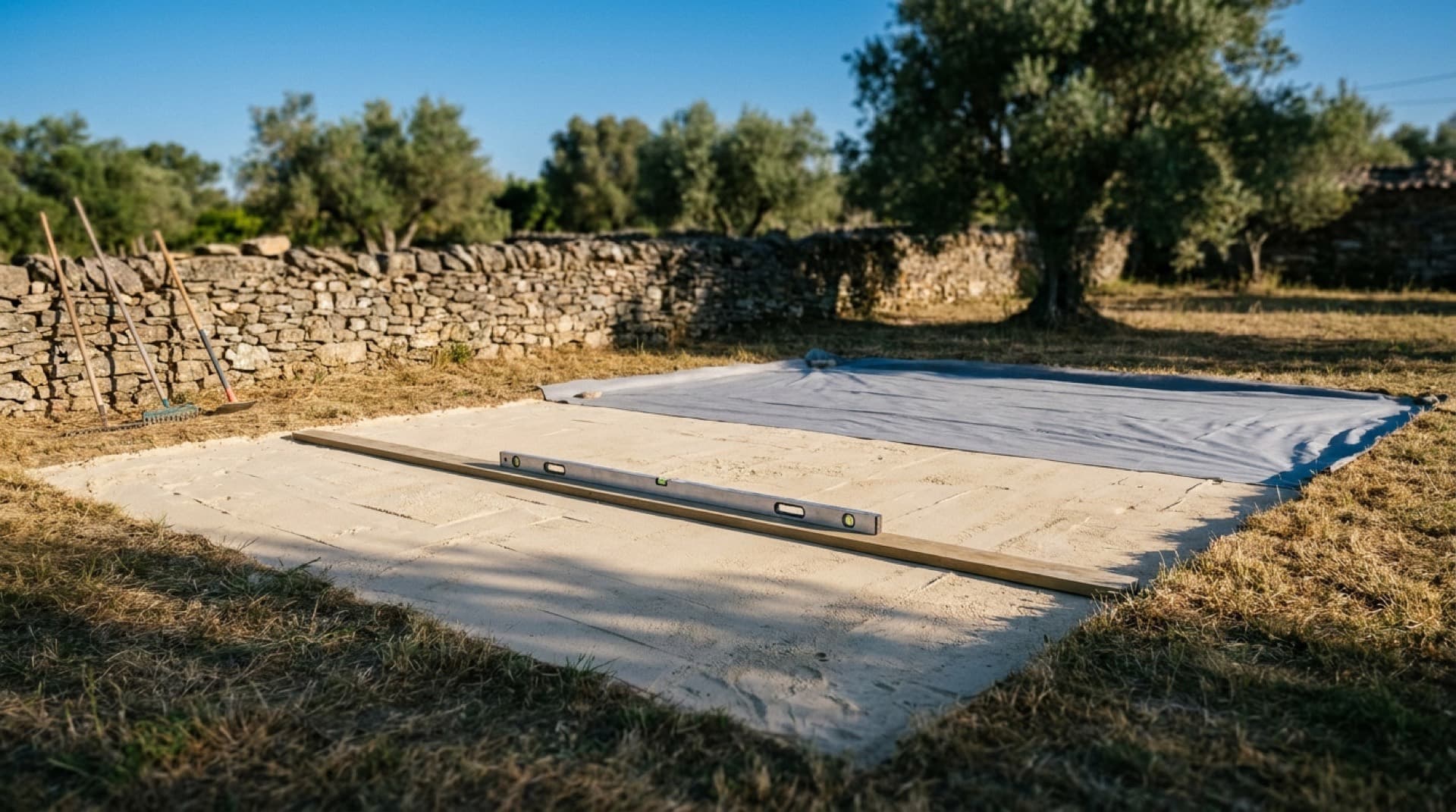
- 7Check level properly: a long spirit level on a straight timber board, rotated across several axes. A short level on its own will lie to you across four metres.
- 8Compact the surface — a hired plate compactor is ideal, a hand tamper is acceptable, treading it down is not. Portuguese summer soil is often dry and dusty, so damp it lightly first.
- 9Spread 2–3 cm of washed sand or fine crushed stone and screed it flat with the timber board. This is the layer that protects the liner and takes out the last small imperfections.
- 10Lay the geotextile ground cloth over the whole prepared area, smoothing out every wrinkle. A fold under the liner becomes a permanent crease and a wear point.
- 11Re-check level one final time with the ground cloth down, then part-fill the pool to about 3 cm and check level again before adding any more water. This is your last chance to correct anything.
Ground Conditions in Portugal
Much of Greater Lisbon and the Silver Coast sits on clay or clay-limestone soils that behave very differently between February and August. Ground that seems rock-hard in July can be soft and mobile after the first autumn rain, so a base prepared in high summer wants slightly more compaction than it appears to need. Sandy coastal soils around Cascais, Estoril and Oeiras drain beautifully but shift under concentrated load, which makes the compaction step and the sand screed more important, not less. Never set an above-ground pool directly onto paving slabs or a patio: the joints transfer point loads straight into the liner, and the pool cannot drain if it does overflow. If you would rather not judge the ground yourself, this is exactly what our team assesses on the site visit — it is the part of the job we would not let a client skip.
How Our Team Can Help
If you would rather not handle this yourself, these are the services that cover what you just read.
Related Problems
Frequently Asked Questions
How level does an above-ground pool need to be?
Within about 2 cm across the whole diameter, and closer if you can manage it. Most manufacturers quote a maximum of 3 cm and treat anything beyond that as voiding the warranty. It is far easier to achieve than it sounds once the topsoil is off.
Can I put an above-ground pool on grass?
Not directly. Grass under a liner dies, rots and settles unevenly, and roots will eventually find their way through. Strip it, level the soil beneath, add a sand layer and a ground cloth. The pool can sit on a lawn — it just cannot sit on the lawn itself.
Do I need concrete under the pool?
No, and a concrete slab often makes things worse: it is unforgiving on the liner, it needs to be perfectly flat and level in its own right, and water that gets underneath has nowhere to go. Compacted soil with a sand screed is both cheaper and kinder to the pool.
What happens if the base is slightly out?
A small error shows as water sitting visibly higher on one side and one part of the wall leaning outward. Take the pool down and correct it — the deformation does not reverse, it accumulates, and each season it gets closer to failing.
How long does base preparation take?
For a typical 4.5 m pool on reasonably flat ground, a full day with two people and the right tools — a plate compactor, a long spirit level and a straight edge you can trust across the whole footprint. On a noticeable slope it becomes two days and needs materials brought in. What fails is doing it by eye, and it fails after the pool is full, when the only remedy left is emptying it.
Need Professional Pool Care?
Our expert team provides comprehensive pool maintenance services across Portugal — so you can enjoy your pool worry-free.