
Keeping the Water Clear
Small volumes swing fast — what a Portuguese summer actually demands
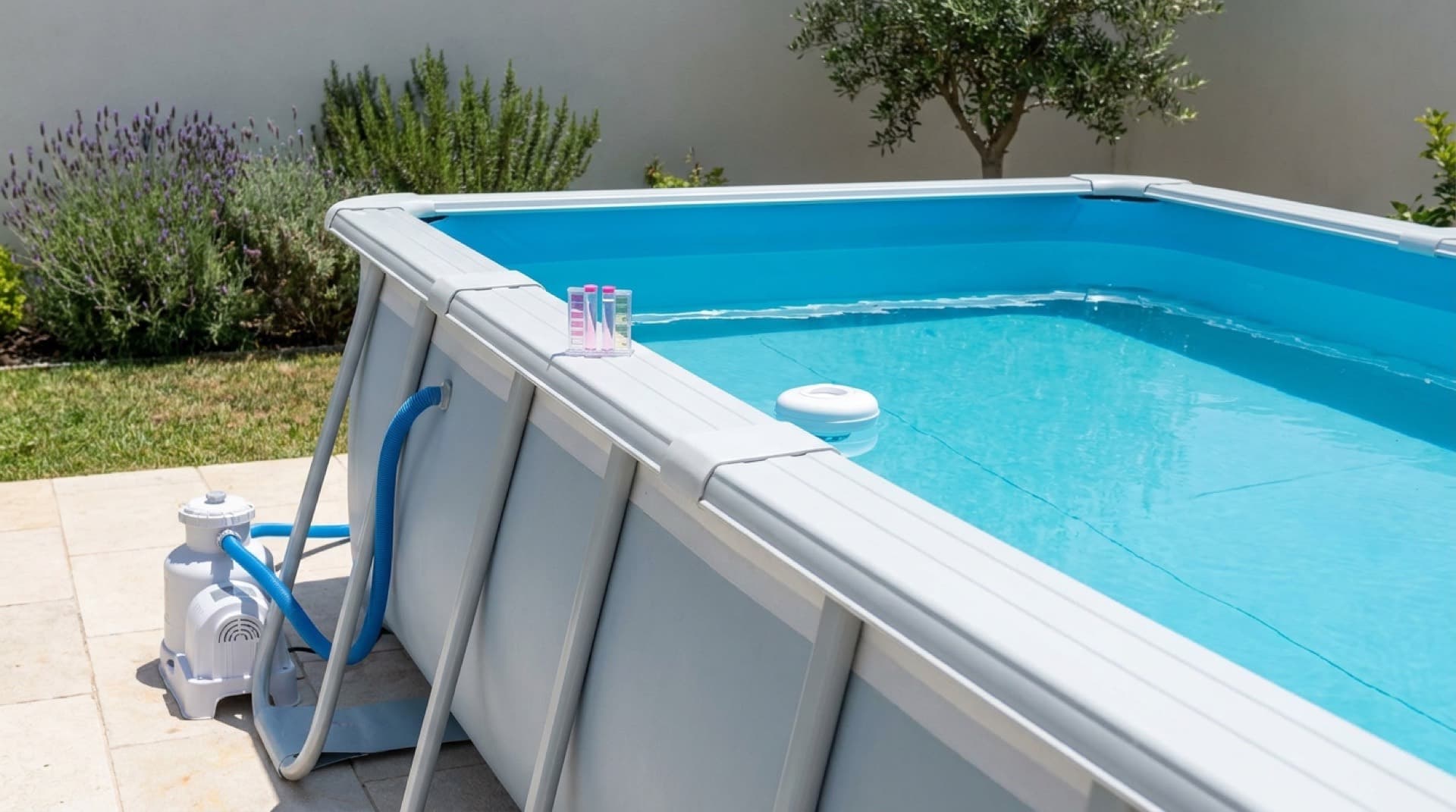
Everything you have read about pool chemistry was almost certainly written for a 40,000-litre in-ground pool. An above-ground pool holds a third of that or less, and that changes the rules completely. Chemistry moves faster, mistakes show within hours rather than days, and the sun does far more damage relative to the volume. This guide is written specifically for small pools in a Portuguese climate.
Why Small Pools Behave Differently
In a 14,000-litre pool, a dose that would be a rounding error in a large pool is a significant change. That cuts both ways: problems appear quickly, but they also correct quickly if you catch them. The bigger issue is heat and light. A shallow pool in full Portuguese sun can reach 30°C by mid-August, which accelerates both chlorine loss and algae growth, while UV strips unstabilised chlorine within hours. Most above-ground pools that go green do so between the third and fifth week of a heatwave, and almost always for the same three reasons.
The Weekly Routine
Twenty minutes a week, plus two minutes a day with the net. That is genuinely all it takes.
- 1Test the water twice a week in high season, and after any heavy use or storm. Chlorine between 1 and 3 ppm, pH between 7.2 and 7.6.
- 2Correct pH before anything else. Chlorine barely works above pH 7.8, so dosing more chlorine into high-pH water simply wastes it.
- 3Run the filter long enough to turn the whole volume over at least once a day — in a Portuguese July that usually means eight to twelve hours, split across the hottest part of the day.
- 4Rinse the filter cartridge with a hose every week, and replace it entirely every three to four weeks. A cartridge that looks clean when wet is usually already restricting flow.
- 5Skim the surface daily. Two minutes with a net removes the organic material that would otherwise consume your chlorine overnight.
- 6Brush the walls and floor once a week, especially the corners and the area under the return jet where circulation is weakest.
- 7Keep the cover on whenever the pool is not in use. It reduces evaporation, keeps debris out and dramatically slows chlorine loss to UV.
- 8Watch the stabiliser (cyanuric acid) level if you use stabilised tablets. In a small pool it accumulates fast; above roughly 50 ppm the chlorine becomes progressively less effective and the only fix is to replace some of the water.
- 9Top up the water level to mid-skimmer. A pool that drops below the intake will run the pump dry and destroy it in minutes.
- 10Shock the pool after heavy use, a party, or a period above 30°C — small pools recover quickly, but only if you act before the water turns.
- 11Check the pump for airlocks and the hoses for weeping at the clamps. Above-ground fittings loosen with thermal cycling far more than fixed plumbing does.
- 12Once a month, look at the frame: legs still vertical, no water pooling under one side, no rust bloom at the joints. Water care and structural care are the same job on these pools.
Through a Portuguese Season
From May into June, a light routine is enough — the water is cool and demand is low. July and August are where above-ground pools are won or lost: water temperatures climb, UV is at maximum, and a pool left for a fortnight while you are away will very often be green when you return. September is easier again, and it is also the point at which most owners stop testing too early, which is why so many pools are put away dirty. If you are away for a stretch of the summer, or you would simply rather not think about it, our team covers above-ground pools on the same maintenance visits as any other pool — the chemistry is smaller, but it is the same work.
How Our Team Can Help
If you would rather not handle this yourself, these are the services that cover what you just read.
Explore More
Related Pool Types
Where We Work
Frequently Asked Questions
Why does my above-ground pool keep going green?
Almost always one of three things: pH too high so the chlorine cannot work, stabiliser accumulated too high from tablets, or the filter simply not running long enough. Test before you dose — adding more chlorine to a pool with a stabiliser problem changes nothing at all.
How many hours a day should the filter run?
Enough to turn the volume over at least once, which for most above-ground pumps means eight to twelve hours in July and August, and five or six in May and September. Run it during the hottest part of the day, not overnight.
Can I use salt chlorination on an above-ground pool?
Yes, and small units designed for these pools exist. It reduces handling of chemicals and gives softer water, but it does not remove the need to test, and salt is corrosive to steel frames if the water is allowed to splash and dry on them repeatedly.
Do I need to empty it and start again if the water goes bad?
Rarely. A small pool responds to shock treatment and continuous filtration within about 48 hours in most cases. The exception is very high stabiliser, where partially replacing the water is the only real remedy — and in a 14,000-litre pool that is far less painful than in a large one.
Is the water safe for children?
When chlorine sits between 1 and 3 ppm and pH between 7.2 and 7.6, yes. The risk with small pools is not over-chlorination but under-treatment during hot spells, when the volume is small, bather load is high relative to it, and the water warms quickly.
Need Professional Pool Care?
Our expert team provides comprehensive pool maintenance services across Portugal — so you can enjoy your pool worry-free.